

Why transaction simulation changes the wallet game — a practical look at Rabby’s multi-chain approach
Surprising fact: one of the most common ways DeFi users lose funds is not a bad private key or a phishing email, but “blind signing” — approving a transaction without a clear, machine-verified preview of what it will actually do. Rabby responds to that problem by putting transaction simulation and risk scanning at the center of a multi-chain wallet experience. For sophisticated U.S.-based DeFi users who move assets across networks, the technical details matter: simulation isn’t a cosmetic feature, it is a mechanism that can change the risk calculus of interacting with composable smart contracts.
This article explains how Rabby’s simulation and pre-transaction risk stack work at a mechanism level, compares trade-offs with MetaMask, Trust Wallet and Coinbase Wallet, and gives a realistic account of where simulations help and where they do not. You’ll finish with a simple decision framework you can use the next time a contract asks you to sign.
How transaction simulation works (and why that matters)
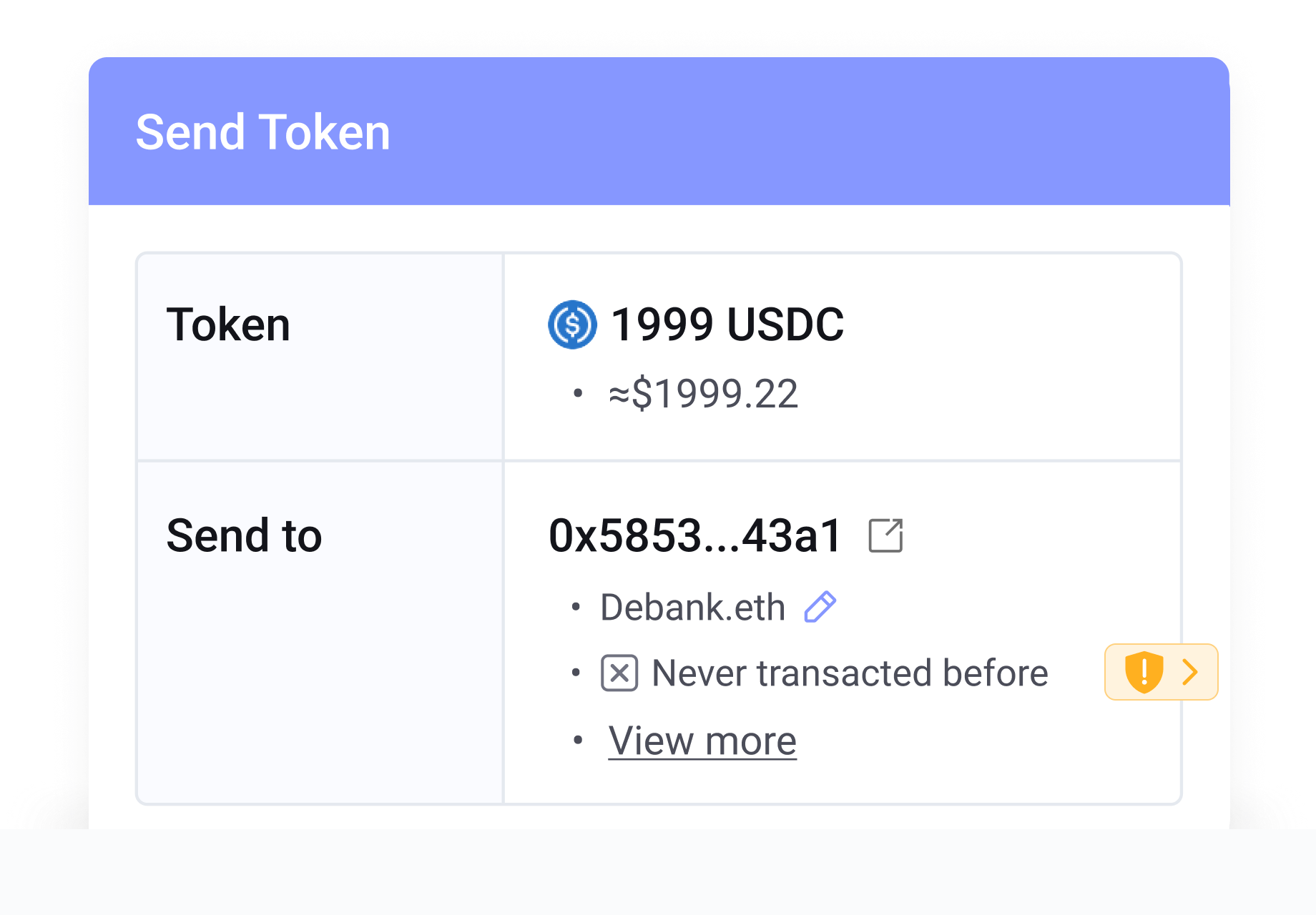
At the basic level, transaction simulation runs the intended transaction against a local model of the chain state to forecast results without broadcasting them. Practically, that means the wallet executes the same EVM bytecode with the pending input and current on-chain data, then reports back the estimated token balance changes, internal calls, and gas used. Rabby presents that output so users see exact estimated token deltas and fee costs before they sign, turning an opaque cryptographic approval into an inspectable economic outcome.
Why that is powerful: composability in DeFi makes single actions multiply their effects across contracts. A simple-looking approval can trigger swaps, liquidations, or nested calls that move funds far beyond what a user expects. Simulation converts an otherwise probabilistic guess into a deterministic preview (subject to race conditions and state changes between simulation and broadcast). For U.S. DeFi power users who often interact with unfamiliar contracts, this reduces the information asymmetry between the dApp and the signer.
What Rabby adds to the basic simulation idea
Rabby combines three mechanisms: (1) pre-transaction simulation that shows token balance changes and fees, (2) a security engine that flags known risky contracts (previously hacked addresses, suspicious approval patterns, non-existent recipients), and (3) built-in approval revocation to reduce lingering exposure. Together these address the classic risk vector: you approve a contract once and forget; later that approval is exploited.
Rabby also bundles practical usability features that interact with security: automatic network switching (the wallet switches to the correct EVM network for a dApp), cross-chain gas top-up (send gas tokens to another chain to enable transactions), and broad hardware wallet support. Those features reduce human error — a common cause of misplaced transactions — and make the simulation output more usable because the wallet is already on the correct chain when it simulates.
Trade-offs: what simulations protect against, and what they don’t
Simulation reduces many risks but it is not a panacea. Useful boundaries to keep in mind:
– Deterministic preview vs. real-time race conditions: simulation runs against a snapshot of chain state. Front-running, sandwich attacks, or state changes from other actors between simulation and inclusion can alter actual outcome. Rabby’s simulation reduces blind signing but cannot eliminate on-chain race risks.
– Known-bad addresses vs. novel exploits: the pre-transaction scanner flags contracts with a history, but novel vulnerabilities or logic flaws in brand-new contracts will not be labeled. The 2022 incident related to Rabby Swap (where about $190k was lost) shows that even teams focused on security can see new attack vectors; the right operational response is active auditing and fast incident response rather than relying solely on a scanner.
– Usability vs. cognitive load: showing every low-level execution detail would overwhelm most users. Rabby chooses a middle path: clear token deltas and fee estimates plus flagged risks. That helps power users but still requires disciplined review — the simulation output is useful only if read and interpreted.
How Rabby compares to MetaMask, Trust Wallet and Coinbase Wallet
Think of three axes: security signaling, institutional integration, and convenience. MetaMask is the default convenience layer for many dApp flows and enjoys the largest ecosystem integration, but historically it has not provided built-in simulation and pre-signing balance previews by default. Trust Wallet and Coinbase Wallet focus on mobile convenience and custodial bridges; they emphasize user onboarding and fiat rails more than pre-signature simulation.
Rabby differentiates by making simulation and automatic network detection first-class features. For users who prioritize preventing blind signing, that is a clear advantage. Where Rabby trades off is in fiat on-ramps (it lacks a native buy-with-fiat flow) and in-wallet staking — both areas where Coinbase Wallet and many custodial/near-custodial alternatives provide smoother UX for on-boarding or yield services.
Institutional or multi-sig users will note another strength: Rabby integrates with Gnosis Safe and enterprise custodial solutions like Fireblocks, Amber, and Cobo Wallet, so it can slot into teams’ custodial or multisig workflows. That makes Rabby more suitable for power users who operate funds on behalf of entities, not just individuals.
Decision framework: when to prefer a simulation-first wallet
Here is a short heuristic for choosing Rabby or a different wallet for a given task:
1) High-value, single-signer transactions (large token approvals, bridged transfers, migrations): prefer simulation-first wallets like Rabby to reduce blind-signing risk. Use hardware wallet integration simultaneously.
2) Routine low-risk interactions (small swaps on trusted DEXes you use daily): convenience-first wallets are acceptable if you maintain safe habits, but keep approval revocation in your toolkit.
3) Institutional/multi-signature flows: choose a wallet that integrates with your custody and signer stack; Rabby’s Gnosis Safe and Fireblocks compatibility makes it a practical option for many setups.
4) New contracts or unknown dApps: always simulate, audit the code or rely on reputable audits, and prefer wallets that flag suspicious patterns. Simulation helps but does not replace due diligence.
Limitations, unresolved questions, and what to watch next
Rabby is open-source under MIT, which is a structural advantage for auditability and community review. But openness is not a guarantee of security — it requires active audits and timely patching. The 2022 Rabby Swap incident is a sober reminder: code-level protections plus operational controls (freeze mechanisms, bug bounties, rapid compensation policies) together define resilience.
Open questions and near-term signals to monitor:
– How simulation handles complex cross-contract, cross-chain interactions especially when relayers or batching services are involved. Current simulations are strong for single-chain EVM execution; cross-chain bridging logic adds complexity that may break simple previews.
– Adoption by institutional flows and whether integration with custody providers results in new standards for pre-signing risk policies. If enterprises require signed, machine-verifiable simulation receipts, wallets that provide structured simulation proofs could gain traction.
– Regulatory scrutiny in the U.S. around custody and transaction transparency. Non-custodial wallets are less directly affected by custody rules, but any wallet offering fiat ramps or custodial bridges will face clearer regulatory design constraints.
For now, the practical implication is straightforward: for U.S. DeFi power users who value security and clarity, a simulation-first wallet reduces a large class of avoidable errors. It is not a guarantee — it shifts uncertainty from “what does this call do?” to “is the simulated snapshot accurate and were there no intervening state changes?”
Where to start if you want to test it
If you want hands-on testing, import a wallet and experiment with simulated small-value transactions across a couple of chains you use regularly (for example Ethereum and Arbitrum). Try an approval flow, inspect how Rabby reports token deltas and gas, then test revoking approvals. Connect a hardware wallet and try the same sequence to see how the UI surfaces signatures and device prompts. That practical rehearsal is the fastest way to internalize what the simulation output actually prevents — and what it leaves exposed.
For more details about the wallet and its features, see this resource on rabby.
FAQ
Does transaction simulation eliminate the risk of smart contract exploits?
No. Simulation reduces blind-signing by showing expected internal effects and balance changes, but it cannot protect against novel logic bugs, zero-day exploits, or changes in chain state between simulation and inclusion. Use simulation as one layer in a defense-in-depth strategy: audits, hardware wallets, approval revocation, and conservative operational limits remain essential.
How does Rabby’s automatic network switching affect security?
Automatic network switching improves usability and reduces human error (e.g., signing on the wrong network). But it increases the importance of verifying destination chains visually: attackers could try to spoof dApp URLs or induce unwanted switches. Combine automatic switching with a habit of quickly scanning the simulated transaction output and the recipient address before signing.
Can I use Rabby with a hardware wallet?
Yes. Rabby integrates with Ledger, Trezor, Keystone, and other hardware wallets. Pairing a hardware signer with Rabby’s simulations is a strong pattern: the wallet provides the preview, the hardware device ensures the private key never leaves secure hardware.
Is Rabby suitable for institutional multi-sig setups?
Rabby integrates with multi-sig and custody solutions like Gnosis Safe and Fireblocks, making it feasible to fit into institutional workflows. However, institutions should validate the wallet against their internal security policies and test integration with their signing and approval processes before custodying large funds.